
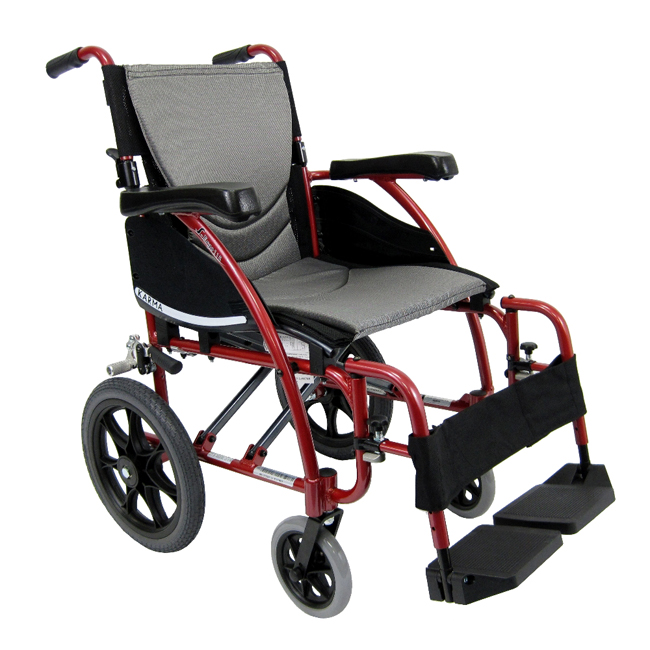

Description
Features
- Anti-bacterial and removable 1/4″ high seat cushion
- Silver frame
- 14″ rear polyurethane flat-free wheels
Key Specs
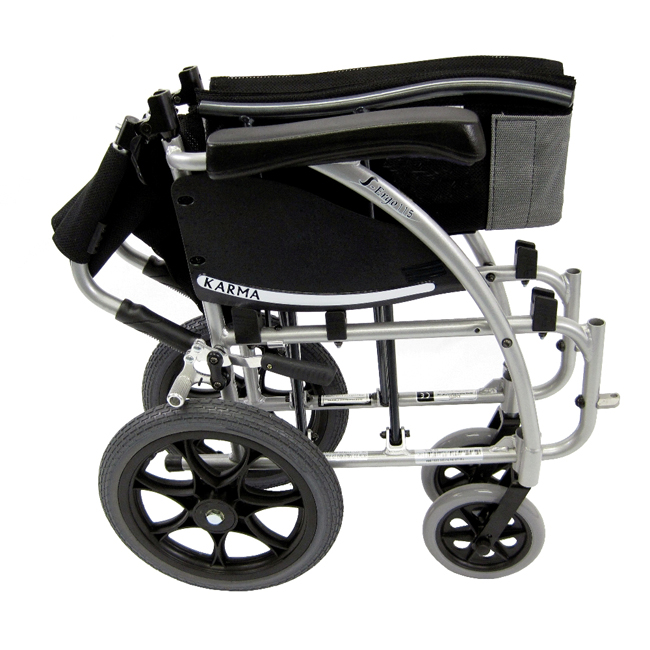
- Overall Width – Folded: 12″
- Quick-Release Axles: No
- Weight capacity: 250 lbs.
- Weight: 22 lbs.
Overview of the Lightweight S-Ergo 115 Transport
The Lightweight S-Ergo 115 Transport wheelchair from Karman Healthcare has all the same great features as the standard S-Ergo 115, but in a lighter weight transport version. The 14″ rear wheels are flat-free high profile polyurethane wheels, making it easier to push and more stable than most transport chairs’ wheels. The backrest easily folds for transportation and storage and it also features a pouch for carrying small items. A 1/4″ thick silver colored anti-bacterial cushion is standard, it is odor and stain resistant and is machine washable.
Ergonomic Seating
The S-styled frame provides a more comfortable and natural seated position keeping the knees bent at a 100º angle and it prevents slippage by placing the legs slightly higher than the lower back. It also has ergonomic handrims and fixed armrests with concave armpads for greater comfort.
Measuring Guide
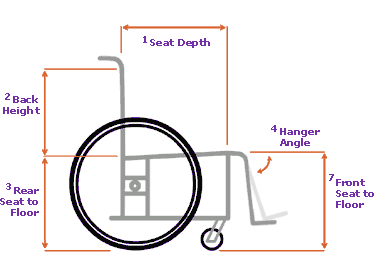
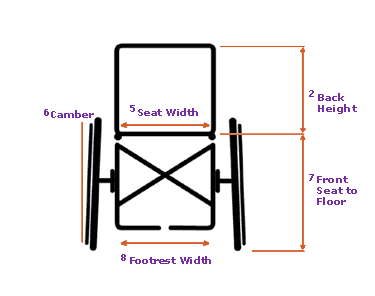
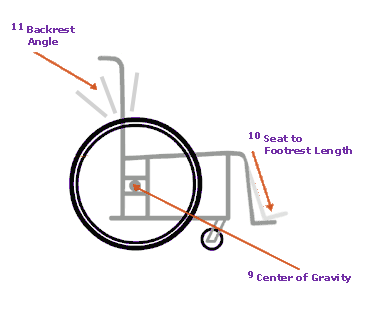
- Seat Depth1
- Measure from the most posterior point of the body to the inside of the knee, minus at least two inches. Some prefer more leg overhang to make room for their hand when lifting their leg.
- Back Height2
- Measured from the seat base to the top of the wheelchair back. Depends on how much upper back support is needed, and also affects freedom for the upper body to rotate.
- Rear Seat to Floor3
- Measurement from the ground to the rear seat edge. Relative to the front seat-to-floor dimension, this determines the rearward slope (“dump” or “squeeze”) of the wheelchair seat.
- Hanger Angle4
- Determines how far the toes extend away from the body, measured from the horizontal. A tighter angle allows the wheelchair to turn around in less space. Depends in part on ability of the knee to bend towards the perpendicular.
- Seat Width5
- Determined by the widest point of the body from knee to hip, plus an inch to ensure room to move. Consider bulk of clothing, particularly a heavy winter coat, if relevant.
- Wheel Camber6
- Angle of the wheel relative to the vertical. More camber improves stability and agility, but also limits ability to pass through narrow spaces. A typical daily wheelchair uses three degrees of camber.
- Front Seat to Floor7
- Measure the leg from the back of the knee to the sole of the foot. Then subtract the thickness of the cushion when it is compressed. Next, add a minimum of two inches for footrest clearance. Do not add the footrest clearance if the wheelchair will be foot-propelled.
- Footrest Width8
- Measure from the inside of each legrest tubing the distance or desired distance between legrests.
- Center of Gravity9
- Measure from the front of the seat back post to the center of the rear axel.
- Seat to Footrest Length10
- Measure from the edge of the seat upholstery to the top rear of the footrest.
- Backrest Angle11
- Measure the the angle of the back post to the floor. Ninety degrees will be perpendicular to the floor, to approximate the angle from the back post to the seat, subtract two degrees from measurment for every .5″ of dump.



Reviews
There are no reviews yet.